ISO Certifications for Accommodation and Food Services: Requirements and Benefits
Introduction
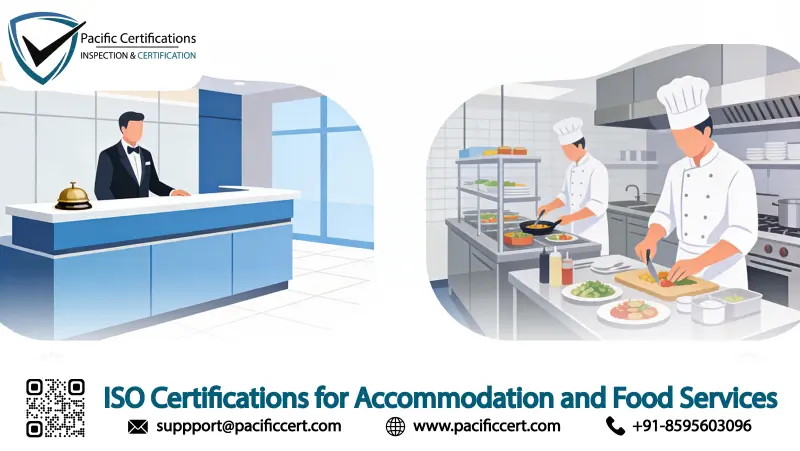
In the competitive world of hospitality and food services, maintaining consistent quality, safety and customer satisfaction is critical. ISO certifications offer a structured way for accommodation providers, restaurants, cafes and catering businesses to formalise their processes, manage risks, and demonstrate commitment to excellence. In 2026, ISO standards help the sector build trust, improve operations and stand out in a crowded market.
Why ISO Certifications Matter in Accommodation and Food Services
-
Stronger Customer Confidence: ISO certificates signal that your business follows internationally accepted best practices.
-
Improved Operational Discipline: Formal processes reduce inconsistencies, errors and service gaps.
-
Enhanced Safety and Compliance: Standards help manage food safety, workplace hazards, hygiene and regulatory requirements.
-
Better Risk Management: Structured frameworks allow organisations to identify, assess and address risks before they impact operations.
Key ISO Standards Relevant to the Hospitality Sector
🍽️ ISO 22000 – Food Safety Management
Helps food service businesses design a food safety system that controls hazards and ensures safe, high-quality food delivery.
🛏️ ISO 9001 – Quality Management
Provides a foundation for consistent service delivery, customer satisfaction and continuous improvement across processes.
🔐 ISO 27001 – Information Security
Important for protecting customer data, reservation systems, payment information and digital platforms in an increasingly digital environment.
🛡️ ISO 45001 – Occupational Health & Safety
Supports safe work environments, reducing workplace injuries and boosting employee well-being.
🌱 ISO 14001 – Environmental Management
Helps operations manage environmental impact — from waste control and energy use to sustainable sourcing and recycling practices.
🧯 ISO 22301 – Business Continuity
Prepares businesses to respond to disruptions — from power outages to supply shortages or emergencies — ensuring continuity of services.
Benefits of Certification for Accommodation & Food Services
-
Consistent Quality and Safety: Standardised systems reduce errors, complaints and hygiene risks.
-
Operational Efficiency: Process discipline improves resource use, waste reduction and cost management.
-
Competitive Differentiation: ISO certification enhances reputation and increases trust among guests and partners.
-
Regulatory Readiness: Better alignment with local and international regulatory standards for safety, health and environment.
-
Employee Awareness and Engagement: Structured practices help staff understand expectations, roles and responsibilities clearly.
Common Challenges in This Sector
-
Treating ISO certification as paperwork rather than a practical system that supports daily operations.
-
Inconsistent documentation for food safety checks, corrective actions or audit trails.
-
Lack of defined metrics to measure performance and compliance.
-
Poor alignment of service delivery with standard-required controls.
-
Limited internal audit practices that don’t catch issues before external assessments.
How Pacific Certifications Can Help?
Pacific Certifications works with accommodation and food service businesses to interpret relevant ISO standards, align internal processes with requirements, develop audit-ready evidence, prepare teams for internal audits and guide organisations through certification assessments with clarity and confidence.
Read the full blog here:
https://blog.pacificcert.com/iso-certifications-for-accommodation-and-food-services/


Comments
Post a Comment